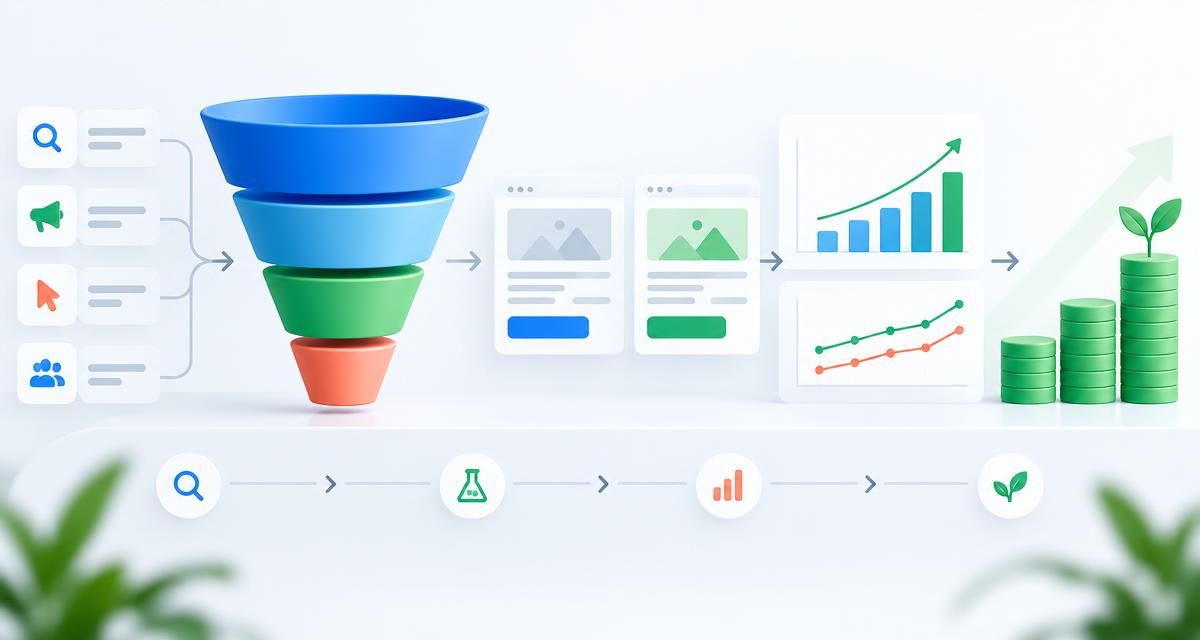
What a conversion rate optimization agency should improve
A conversion rate optimization agency should improve the percentage and quality of visitors who become real sales opportunities. That means the work must extend beyond button colors and headline swaps. It starts with the promise made in search results or an ad, continues through the page and form, and ends when sales can identify whether the lead became pipeline and revenue.
We audit the complete path: traffic source, query or audience, offer, page message, proof, call to action, form, phone experience, scheduling, qualification, and follow-up. A weak handoff at any point can erase gains made earlier. A shorter form may increase submissions while lowering sales acceptance. A stronger offer may lift response while attracting buyers outside your economics. We evaluate both the immediate conversion and the downstream result.
That revenue lens is what separates specialist CRO from general website improvement. The goal is not the highest possible form rate. The goal is the most profitable combination of conversion rate, lead quality, close rate, and customer value. This specialist work supports our broader performance marketing agency model, where acquisition, conversion, and attribution operate as one system.
Start with evidence instead of opinions
Effective CRO begins by identifying what visitors do, what they expected, and where confidence breaks. Analytics shows the size and location of the leak. Call recordings, sales notes, search terms, surveys, and customer interviews explain why it happens. Session recordings and form analytics reveal friction that aggregate reports cannot show. Together, those inputs create testable hypotheses.
We separate technical friction from message friction. Technical problems include slow pages, broken tracking, poor mobile controls, validation failures, and scheduling errors. Message problems include vague positioning, an offer that does not match the query, missing proof, unclear pricing context, and calls to action that ask for too much commitment. Fixing obvious failures comes before experimentation because testing a broken experience only measures the damage.
Every finding enters a prioritization model using potential impact, confidence, implementation effort, and time to learn. A high-traffic page with a clear form failure moves ahead of a low-traffic page with a subjective design concern. This gives leadership a visible rationale for what ships next and prevents the testing backlog from becoming a collection of stakeholder preferences.
Build tests around business hypotheses
A CRO test is useful only when it states what will change, why that change should affect behavior, which audience should respond, and how success will be judged. We write the hypothesis before design begins. For example: clarifying who qualifies for a consultation will reduce total form fills but increase sales-accepted opportunities, lowering cost per qualified opportunity.
The test design follows the available volume. High-volume funnels can run controlled A/B or multivariate experiments. Lower-volume B2B sites need a different toolkit: sequential tests, message testing, prototype interviews, call-review coding, before-and-after analysis with seasonality controls, and changes grouped by one strategic hypothesis. Declaring a winner after a handful of conversions creates false certainty, so we document sample size, duration, external changes, and confidence.
We also protect against local wins that damage the larger funnel. If a page test lifts booked calls but increases no-shows, it is not a clean win. If a shorter form raises leads while sales wastes hours qualifying them, it may increase acquisition cost. The scorecard includes revenue per visitor, qualified conversion rate, opportunity rate, and close rate alongside page-level metrics.
Optimize the entire conversion path
Full-funnel CRO aligns the page, form, phone, scheduler, and follow-up experience around one clear next step. On landing pages, we test the offer hierarchy, category language, proof placement, objection handling, and information order. On forms, we examine field value, error handling, progressive disclosure, qualification logic, privacy reassurance, and the mobile keyboard experience. For phone-led businesses, we measure tap-to-call behavior, answer rate, routing, hold time, and call outcomes.
The post-conversion experience receives equal attention. Confirmation pages should set expectations and reduce no-shows. Routing rules should send high-value inquiries to the right person immediately. Automated acknowledgment should be fast without pretending a human has reviewed the request. Calendar flows should protect sales capacity while making the next available step obvious. CRM stages need definitions that allow marketing and sales to agree on what qualified means.
This work complements the paid acquisition, landing-page, and attribution specialty on our paid performance marketing page. Paid media creates controlled traffic and fast learning. CRO turns that traffic into evidence about buyer motivation. Attribution then confirms whether the improvement survived the full sales cycle.
A practical 90-day CRO operating system
The first 30 days establish measurement and remove preventable friction. We verify analytics events, call tracking, CRM source capture, consent behavior, form delivery, mobile performance, and thank-you flows. We review the highest-value pages and build a baseline by source, device, offer, and lead quality. Customer and sales language becomes the raw material for the first message changes.
Days 31 through 60 focus on the highest-confidence hypothesis. That may be a new landing-page structure, a clearer offer, a shorter qualification path, or a stronger proof sequence. We create the control and variant, define the audience and stopping rule, and document other campaign changes that could affect the result. The same period produces the next two hypotheses so learning does not stop while one test runs.
Days 61 through 90 connect results to sales outcomes and establish cadence. We compare qualified opportunities and revenue, not just submissions. Winning patterns become reusable standards for future pages. Losing tests remain valuable because they remove unsupported assumptions. The result is an experimentation backlog tied to commercial impact, an executive scorecard, and a repeatable monthly cycle of research, test, learn, and scale.
Common CRO mistakes that waste traffic
The most common mistake is copying a competitor's page without knowing whether it works or whether its audience resembles yours. Another is changing several unrelated elements at once, which makes the result impossible to explain. Teams also stop tests early after seeing a favorable swing, ignore device and source differences, or optimize a micro-conversion that has no relationship to revenue.
A second group of mistakes comes from weak measurement. Duplicate events inflate conversion counts. Call clicks get counted as calls. Spam submissions appear as leads. Offline sales outcomes never return to the analytics system. When the baseline is unreliable, even a statistically clean experiment can optimize the wrong behavior. Measurement repair is part of CRO, not a separate technical chore.
Finally, many programs treat trust as decoration. Buyers need specific proof near the decision it supports: process evidence beside delivery claims, credentials beside expertise claims, and clear expectations beside the form. Unsupported urgency, invented scarcity, and overpromising may lift short-term response while damaging lead quality and brand trust. Sustainable conversion improvement removes uncertainty without manipulating the buyer.
Related reading: performance marketing agency, paid acquisition and attribution, conversion optimization delivery, marketing ROI calculator, plan a CRO sprint.