What an AI marketing agency should deliver
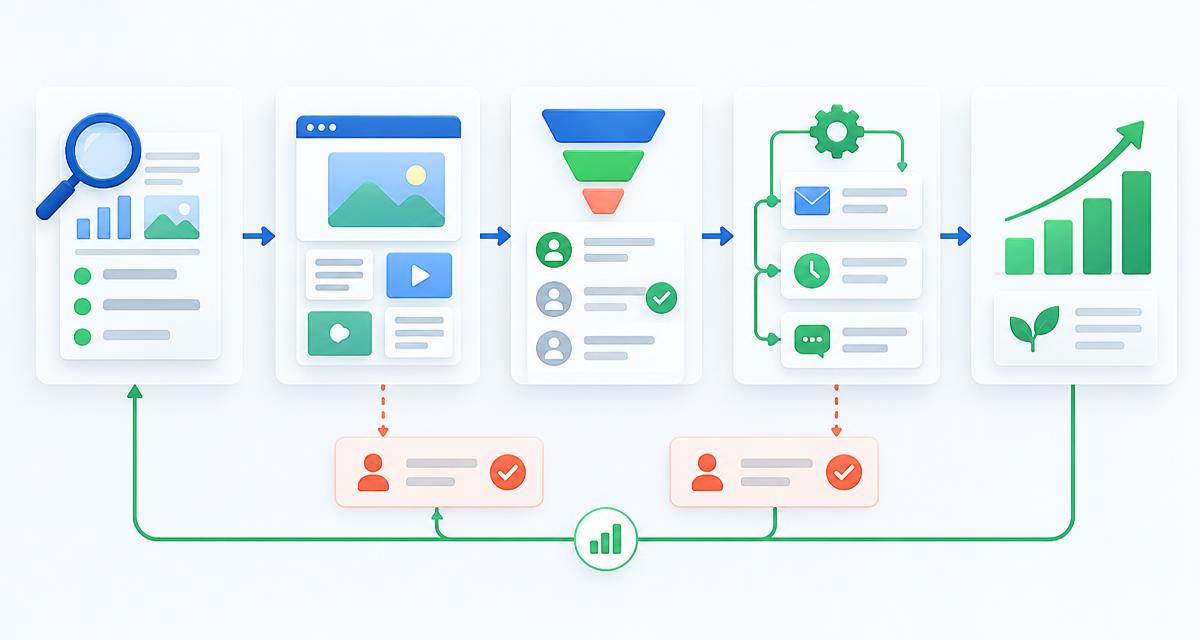
An AI marketing agency should deliver a better operating system, not a pile of prompts. The work begins by mapping how research, planning, production, review, distribution, lead handling, and reporting happen today. We identify where work waits, where knowledge gets lost, where errors repeat, and where a machine can assist without taking responsibility away from a person.
The resulting system combines deterministic automation with bounded AI tasks. Rules handle predictable events such as form routing and approval status. AI handles work that requires classification, summarization, extraction, or a first draft. People own the market judgment, offer, factual approval, creative direction, and final decision. Every handoff has a named owner and a fallback when confidence is low.
AI is an operating layer within our broader performance marketing agency model. It can shorten the distance from customer insight to campaign, or from inquiry to response, but it cannot replace positioning, demand creation, conversion strategy, or revenue accountability. We judge the work by cycle time, quality, pipeline, and cost, not by the number of automated steps.
Choose workflows with measurable constraints
The best first workflow is frequent, time-consuming, and easy to verify. Research teams may spend hours turning interviews, calls, and search data into themes. Content teams may rewrite the same source material for multiple channels. Paid teams may manually check naming, links, tracking, and policy requirements. Sales teams may wait too long for lead context. Each constraint has a different automation pattern and risk level.
We score candidates by business impact, repetition, data readiness, reviewability, sensitivity, and failure cost. A high-volume classification task with clear labels is a stronger candidate than a once-a-quarter strategic decision. A customer-facing output with legal or financial claims needs more control than an internal summary. This prevents leaders from automating the most visible task instead of the most valuable one.
Before implementation, we capture a baseline: minutes per case, monthly volume, rework rate, response delay, acceptance rate, and downstream outcome. The baseline creates a financial model for the change. If a workflow cannot produce enough savings, speed, or conversion value to justify maintenance and review, we do not recommend building it.
Create a controlled marketing knowledge layer
AI output is only as dependable as the context it receives. We organize approved brand language, service definitions, pricing access, customer evidence, editorial rules, product facts, audience research, and prohibited claims into a controlled knowledge layer. Source ownership and update dates matter because stale facts can spread quickly once automation increases output.
Different tasks receive different context. A sales-call summary needs the transcript, CRM fields, and qualification criteria. A campaign brief needs the audience, offer, channel constraints, previous performance, and approved proof. A content draft needs the source interview, research references, internal-link strategy, and editorial standards. Giving every task the entire knowledge base increases cost and can reduce accuracy.
We also define what must never enter a public model or an unapproved workflow. Personal data, client-confidential information, credentials, and sensitive commercial documents require strict handling. Access follows the person's role, and logs show what source material informed important outputs. Governance is part of useful AI operations, not an obstacle added after launch.
Accelerate research and campaign production
AI can compress the time between raw evidence and a usable campaign plan. It can group call themes, compare search intent, extract objections, identify repeated questions, and create a structured research brief. A strategist then validates the themes, selects the commercial angle, and decides what the market should hear. The model prepares the field; it does not choose the strategy.
During production, the system can adapt an approved source into campaign variants, landing-page sections, nurture drafts, social excerpts, and sales enablement. Each output inherits the same core claim and evidence instead of drifting into channel-specific invention. Reviewers see the source, the transformation instructions, and the claims that require confirmation. Accepted changes feed future templates.
This approach increases reuse without flooding the market with generic content. One expert interview can support several valuable assets because the source contains genuine experience. A weak source simply produces weak variations faster. We therefore invest first in the primary idea, evidence, and point of view, then use AI to expand distribution while maintaining human editorial accountability.
Improve lead response and lifecycle operations
AI-supported lead operations turn unstructured inquiries into actionable context. A workflow can summarize a message, classify service interest, flag urgency, identify missing qualification details, and prepare a response for review. Deterministic rules then route the inquiry based on territory, service, account ownership, or business hours. High-value or uncertain cases go directly to a person.
Lifecycle workflows can use approved CRM events to prepare follow-up suggestions, surface dormant opportunities, summarize account history, and identify content relevant to the buyer's current question. Consent, frequency limits, and channel preferences remain explicit rules. The system should never invent a relationship, hide that a response is automated, or continue contacting someone who has opted out.
Speed matters, but relevance and ownership matter more. A fast generic reply can reduce trust. We measure first-response time alongside meeting rate, sales acceptance, unsubscribe rate, and pipeline. That keeps the automation connected to the buyer experience and prevents a volume metric from masking poor outcomes.
Govern AI with human review and clear boundaries
A governed AI workflow assigns risk levels before launch. Low-risk internal transformations may run automatically with periodic sampling. Medium-risk drafts require human approval. High-risk outputs involving pricing, legal interpretation, health claims, customer commitments, or sensitive data require named expert review and may remain fully manual. The controls should match the consequence of failure.
We use structured output formats, source citations, confidence thresholds, prohibited-action rules, audit logs, and fallback paths. Prompts and model settings are versioned so a performance change can be traced. Reviewers are trained to check facts, not merely polish tone. When the system lacks evidence, the correct response is to flag the gap rather than generate a plausible answer.
Governance also covers brand quality. AI tends toward familiar phrases and average category language. Editorial standards preserve the company's point of view, banned claims, terminology, and punctuation. Human experts add judgment and lived experience. This partnership produces work that is faster without becoming anonymous or interchangeable.
Measure AI operations against revenue and quality
AI marketing measurement compares the old and new workflow. Operational metrics include cycle time, cost per completed task, percentage accepted without rework, error rate, queue time, and reviewer effort. Commercial metrics depend on the workflow: speed-to-lead, sales acceptance, campaign launch velocity, qualified conversion rate, pipeline influenced, or retention.
A worked example makes the distinction clear. If a research brief drops from eight hours to three but requires two hours of hidden correction, the net gain is three hours, not five. If faster lead summaries reduce response time but lower meeting quality, the workflow needs better qualification rules. We include maintenance, model usage, integration, and oversight when evaluating return.
The first 90 days should prove one or two bounded workflows, not transform the whole department. We map and baseline in the first month, build and test in the second, then compare quality and commercial outcomes in the third. Proven patterns can expand. Failed assumptions are documented before they spread. This creates an AI capability the business can manage rather than a collection of fragile experiments.
Related reading: performance marketing agency, AI automation services, AI search authority resources, our operating approach, map an AI workflow.