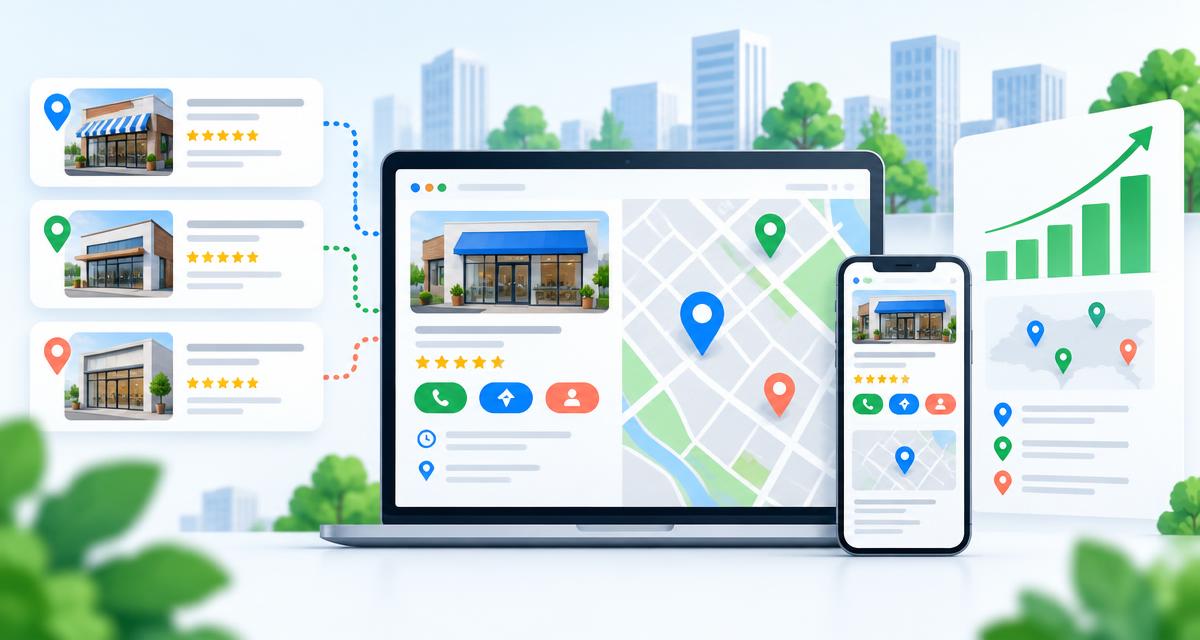
What Google Business Profile optimization includes
Google Business Profile optimization is the management of the facts, categories, media, offers, reputation signals, landing-page connections, and measurement surrounding a local business record. The profile has two audiences. A prospective customer needs enough confidence and context to choose the next action. Google's systems need consistent evidence that the business is eligible, relevant, located or serving where claimed, and represented accurately.
The work starts with ownership, eligibility, name, address or service-area settings, phone, website, hours, and primary category. It continues through secondary categories, services, products where appropriate, attributes, appointment links, descriptions, photos, videos, posts, questions, and review responses. Every field must match the real business and current policy. More fields are not automatically better.
This specialist page covers profile operations. Our local SEO service covers the wider system, including website structure, local landing pages, citations, technical SEO, content, and authority. Both support the larger performance marketing goal: converting demand into trackable business outcomes rather than treating map visibility as the finish line.
Establish eligibility and accurate ownership
Profile performance begins with a record that should exist. Storefront businesses need real customer-facing locations with accurate hours and signage. Service-area businesses need settings that reflect how they operate and should not create virtual offices or duplicate profiles to manufacture coverage. Practitioners, departments, and multi-location brands each have specific eligibility questions that must be resolved before optimization.
We document who owns the profile, who has management access, which email domain controls it, and how recovery would work if an employee or vendor leaves. Access follows job responsibility. Shared credentials are avoided. The canonical business name, address, phone, website, and category are compared with the website and important third-party records so customers and systems receive the same facts.
This foundation protects the business. Aggressive keyword additions to the name, false locations, conflicting hours, and duplicate listings can trigger edits or suspension. Optimization should reduce risk while improving relevance. We record major changes and maintain evidence that supports the representation, allowing the team to respond quickly if the profile is challenged.
Align categories, services, and local landing pages
The primary category is one of the most consequential profile decisions because it describes the business's central function. Secondary categories add legitimate lines of service without turning the record into a list of every adjacent term. We review the categories available in the market, competitor patterns, actual revenue priorities, and the language customers use before recommending changes.
Services and products should clarify what a buyer can obtain, who it fits, and where to learn more. The linked landing page must continue the same intent. Sending every profile to a generic homepage can force a buyer to restart the search. For multi-location businesses, each location page needs unique operational facts, relevant service information, embedded contact options, and a clear relationship to the correct profile.
This alignment creates a coherent path from query to profile to website. It also improves measurement because each location or service link can carry its own campaign tags and conversion events. A profile view is useful, but a tracked call, booking, form, or sale is the outcome leadership can evaluate.
Use photos, posts, and questions to reduce uncertainty
Profile content should help a customer verify that the business is current and appropriate. Real exterior, interior, team, equipment, process, and completed-work photos often answer practical questions faster than polished stock images. Captions and file organization support internal governance, while regular uploads keep each location represented accurately. We do not use misleading images or upload the same generic set everywhere.
Posts can communicate timely offers, events, service updates, seasonal considerations, and useful resources. They work best as a supporting communication channel, not a substitute for durable website content. Each post needs a clear destination and consistent offer. Questions and answers should address genuine customer concerns with factual responses and regular monitoring for inaccurate community submissions.
The content cadence follows the business. A seasonal home service needs different updates from a professional office or multi-location healthcare group. We create a repeatable calendar, asset checklist, approval process, and ownership model so the profile remains current after the initial optimization.
Build a compliant review-response operation
Reviews influence how buyers interpret the profile and provide direct language about service experience. A sound program asks real customers for honest feedback at a consistent moment, makes the process simple, and respects platform policy. It does not buy reviews, gate unhappy customers, incentivize only positive responses, or use automation to manufacture content. We cannot automate review generation and never claim to do so.
Response workflows define who monitors, who approves sensitive replies, what can be acknowledged publicly, and when an issue should move to a private channel. Templates can establish tone and structure, but every reply should reflect the actual review. Personal information, account details, and disputed facts should not be exposed in a public response.
We categorize recurring themes so reviews also become operational feedback. Repeated praise can identify authentic proof. Repeated confusion may reveal a gap in the profile, landing page, scheduling, or service handoff. The measure is not simply review count. Response time, theme, sentiment direction, conversion behavior, and resolved operational issues all matter.
Defend profiles and govern multiple locations
Profile governance protects each record from unauthorized edits, duplicates, category drift, and spam in the surrounding results. We monitor ownership, manager access, key fields, status, user-suggested changes, and policy notifications. For obvious competitor spam, we document the issue and use the appropriate reporting process without making unsupported accusations.
Multi-location programs need a source of truth for names, addresses, phone numbers, hours, categories, URLs, managers, and temporary changes. Bulk operations still require local accuracy. Holiday hours, closures, relocations, new services, and appointment links need a documented approval and publishing process. A central standard prevents inconsistency, while location owners confirm facts that headquarters cannot know.
We also plan for exceptions. A suspension requires evidence and a measured appeal, not repeated edits. A duplicate may need merging rather than deletion. A moved location needs a coordinated website and citation update. Written playbooks reduce downtime and prevent a rushed response from creating additional policy problems.
Measure profile visibility through qualified leads
Profile reporting should connect visibility to customer action. We track discovery and branded visibility, website clicks, calls, messages when enabled, booking actions, and direction requests. Website links use campaign parameters. Call tracking is configured to preserve the business's primary number where appropriate. Forms and booking tools carry source data into the CRM.
Platform metrics have limits. A call click does not prove a connected call, and a direction request does not prove a visit. We therefore compare profile interactions with call outcomes, booked appointments, qualified inquiries, sales opportunities, and revenue where the systems permit. Location-level reporting highlights where operational response, not visibility, is the constraint.
A practical first 90 days covers access and eligibility, data cleanup, category and service alignment, media and review workflows, landing-page connections, and baseline measurement. The next phase follows evidence: strengthen weak conversion paths, address competitive gaps, and scale governance across locations. This is how profile activity becomes a managed acquisition channel instead of a monthly screenshot.
Common profile optimization mistakes
The most damaging mistakes trade short-term visibility tactics for long-term instability. Adding keywords to the business name, creating profiles at ineligible addresses, selecting unrelated categories, or building duplicates can lead to edits and suspension. A complete profile that misrepresents the business is worse than an incomplete but accurate one.
Another mistake is treating the profile as independent from the website. Mismatched services, phone numbers, hours, and location pages confuse buyers and weaken measurement. Sending every location to the same generic page hides local facts. Publishing frequent posts while forms fail or calls go unanswered optimizes activity instead of outcomes.
Finally, teams often report raw interaction counts without lead quality. Higher calls may include wrong numbers, job applicants, or unqualified inquiries. We define conversion events and sales stages before making performance claims. That discipline keeps optimization tied to real demand and supports more credible decisions about local search investment.
Related reading: performance marketing agency, local SEO services, reputation management systems, Business Profile optimization guide, request a profile audit.