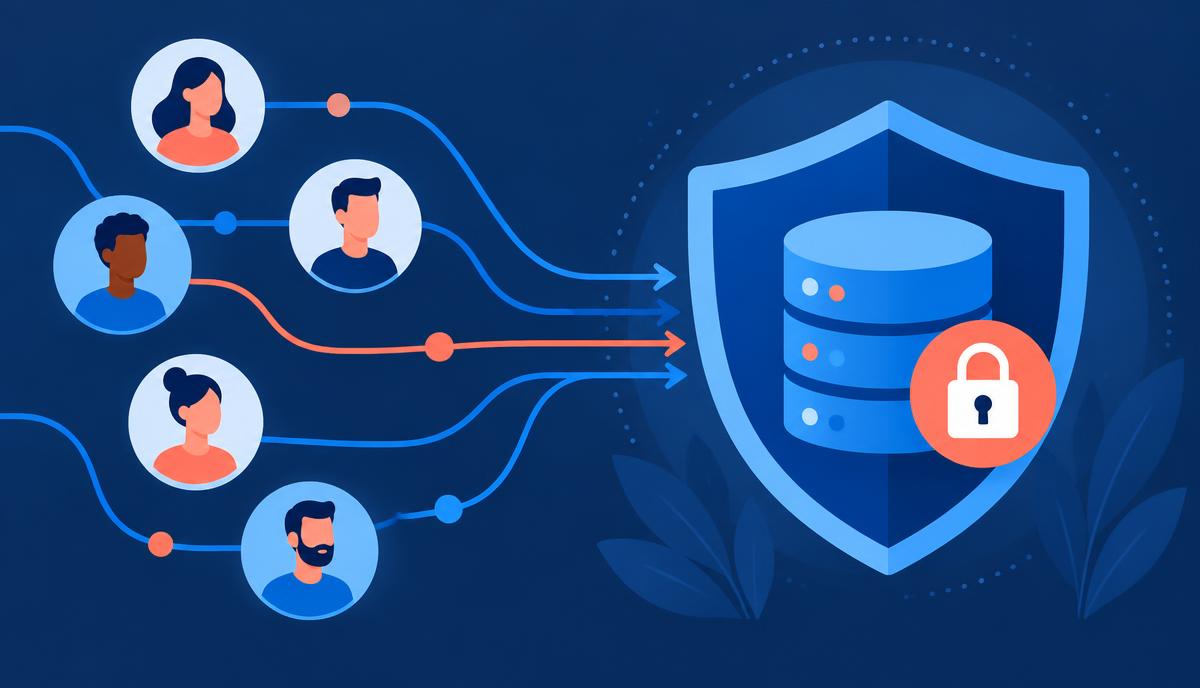
First-party data activation is the step where information you already own starts changing what a customer actually experiences. Collecting the data is the easy part and most firms stop there, sitting on a CRM full of behavior that never influences a single email, ad audience, or web page. A Greensboro service business with even a modest CRM already has enough raw material to start.
Collection Is Not Activation for a Greensboro Business
A typical service business already holds more first-party data than it uses: form submissions, call recordings, email engagement, page-level behavior, purchase history, support tickets, and appointment records. The gap is not acquisition. It is that none of it is wired to a decision.
Activation means a specific, testable statement of the form when this is true about a person, this changes. If you cannot phrase a data initiative that way, it is a reporting project wearing a personalization costume.
Four Activations Worth Doing First
Suppression
The fastest return in the list, and the least glamorous. Exclude current clients, recent buyers, unqualified geographies, and known competitors from paid audiences. Most accounts we review are spending 8 to 20% of their budget reaching people who cannot or should not convert.
Lookalike seeding from revenue, not leads
Feed platforms a hashed list of your highest-value closed clients rather than all form fills. The audience quality difference is substantial because you are asking the platform to find buyers instead of browsers.
Content routing on the website
Returning visitors who previously read industry-specific pages should see that industry's case study in the featured slot. This is a modest, tasteful change, and it consistently lifts engagement more than broad personalization schemes that rename the visitor in a headline.
Lifecycle-triggered outreach
Contract renewal windows, service anniversaries, and post-project checkpoints are first-party facts sitting in your systems. Turning them into scheduled outreach is typically the highest-margin revenue a service business can find.
The Minimum Viable Stack
You do not need a customer data platform to start. For most firms under $25M, the practical stack is the CRM as the system of record, a marketing automation tool for sequences, server-side conversion sending to ad platforms, and a scheduled sync that pushes segments outward. Add heavier infrastructure only when the manual sync becomes the bottleneck.
- Decide the single system of record and stop debating it.
- Define five to eight segments tied to real actions, no more.
- Automate the sync so segments update at least daily.
- Instrument outcomes per segment so you can prove the activation worked.
Consent, Retention, And Doing This Cleanly
First-party does not mean unrestricted. Three practices keep the program defensible as rules tighten.
- Collect purpose alongside consent. Record what the person agreed to at the moment they agreed, not as a blanket checkbox.
- Set retention windows. Behavioral data older than 18 months is rarely predictive and is pure liability to hold.
- Honor deletion across systems. A request satisfied in the CRM but not in the ad platform or the email tool is not satisfied.
Hash identifiers before sending them anywhere, keep sensitive categories such as health or financial detail out of ad platforms entirely, and document who can export what. These are small disciplines that prevent large problems.
Measuring Whether Activation Paid
Hold out a control. Personalization projects have a habit of reporting improvements that were seasonal. Withhold 10% of an eligible segment from the treatment for six to eight weeks and compare conversion, revenue per contact, and unsubscribe rate. If the treated group is not clearly ahead, revert and try a different activation rather than adding complexity on top of a null result.
Reasonable expectations for a first pass: suppression saves 8 to 20% of wasted paid spend, revenue-seeded lookalikes improve qualified lead rate by a fifth or more, and lifecycle triggers produce steady incremental revenue that grows with your client base.
Common Mistakes
- Buying a platform before defining an activation. Tooling does not create the decision the data should change.
- Over-personalizing. Referencing behavior the customer did not know you tracked reads as surveillance, not service.
- Segment sprawl. Thirty segments nobody maintains is worse than six that stay accurate.
- Ignoring data quality. Duplicate contacts and stale emails undermine every downstream activation.
Start with suppression this month. It requires no new tools, produces a measurable saving within two weeks, and builds the plumbing every later activation depends on. From there, work down the list one activation at a time, each with its own holdout and its own written sentence. The reporting that proves the value belongs in the same view described in our marketing ROI dashboard guide, and this performance marketing agency builds these pipelines as part of ongoing engagements.
A Worked Example for a Greensboro Firm
Consider a Greensboro service business spending $10,000 a month on paid social and search. If 15% of that spend, a reasonable midpoint for accounts that have never suppressed existing customers, is reaching people who cannot convert, suppression alone recovers roughly $1,500 a month without touching creative or bidding. Redirected into prospecting, that is real incremental reach at zero added cost.
A revenue-seeded lookalike built from the firm's top 200 closed clients, rather than all 3,000 historical form fills, commonly improves qualified lead rate by 15 to 30% in the first two months. Results vary with list size and platform maturity, so treat the low end of that range as the planning assumption.
A Ninety Day Path to Activation
- Days 1 to 15: audit what data already exists across the CRM, website, and ad platforms, and write the first activation sentence.
- Days 16 to 30: build the suppression list and confirm it is excluding current clients across every ad platform in use.
- Days 31 to 60: build the revenue-seeded lookalike audience and launch it alongside, not instead of, the existing prospecting campaign.
- Days 61 to 90: add one lifecycle trigger, such as renewal window outreach, and measure all three activations against a holdout.
What to Ask a Data or CRM Vendor
- Can they export a hashed customer list without exposing raw personal data to the ad platform?
- How do they handle a deletion request across the CRM, email tool, and ad accounts simultaneously?
- What is their default data retention window, and can it be shortened?
- Do they support server-side conversion tracking, or only client-side pixels that degrade with browser privacy changes?
Budget and Staffing Considerations
Most Greensboro firms under $25 million in revenue do not need a dedicated data analyst to start. A marketing lead who can export a segment and load it into an ad platform, paired with a few hours a month from whoever manages the CRM, is enough to run suppression and one or two lifecycle triggers. Budget for a customer data platform only once manual syncing between systems becomes the actual bottleneck, which for most businesses this size is a problem worth having in a year or two, not on day one.
Put the Data Your Greensboro Business Already Owns to Work
We turn CRM and behavioral data into working suppression lists, revenue-seeded audiences, and lifecycle campaigns, with consent handled properly. Ask this performance marketing partner what your existing data could be doing.
Book a Free Strategy Call